
From Nosferatu to Edward Cullen: the changing face of the vampire
Vampires have always been a lightning rod for prevailing social anxieties: finding new meaning and resonance in the face of each decade like a cinematic chameleon. It is this elasticity that audiences find so appealing: from terrifying silent film figure, British Horror Icon, to teen heart-throb; there are no limits to interpretations of the vampire, unlike other rigid, onscreen monsters such as Frankenstein, zombies, or Ricky Gervais…

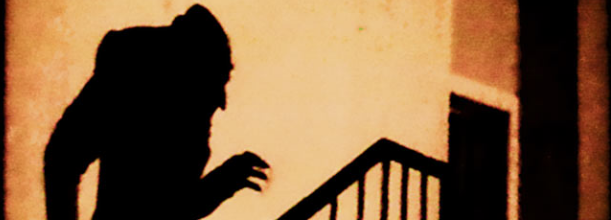
German Expressionist director F. W. Murnau kick-started the phenomena with Nosferatu– a thinly veined exploitation of Bram Stoker’s novel starring the aptly named Max Schrek as ‘Count Orlok’: a bald, cadaverous, animalistic creature with terrifyingly elongated fingers. Utterly repugnant- he is the furthest thing from erotic that could ever be imagined, bar Vince Vaughan – his victims dying instantly as though he is plague personified. After an epic battle with Stoker’s widow however, Nosferatu was forced completely out of circulation. Time for Hollywood’s to step up, with Dracula in 1931 starring Bela Lugosi – who came directly from the successful stage play:

With his slicked black hair, prominent widow’s peak, dark exotic looks, evening dress and slow Hungarian drawl, Lugosi’s Dracula was more of a romantic, mysterious stranger; the type who casually conversed with busty maidens in their drawing rooms. As a vampire he is distinctly supernatural: creeping into bedrooms in the form of mist, the more grisly acts of vampirism performed off screen as Dracula fails to bare his fangs. Although vastly less scary, Lugosi’s Dracula would become synonymous with the vampire – not to mention the most parodied.
Two years after Lugosi’s death, Dracula was reincarnated for a new generation as Hammer Horror Studios released Horror of Dracula (1985) starring a dastardly dashing Christopher Lee:

Although similarly costumed, Lee’s Count was a different beast: filmed in glorious Technicolor, his fangs dripping with blood, he presented an ironically ‘hot-bloodied’ vamp that was both predator and heart-throb on the eve of the ‘swinging sixties’. Littered with phallic, sexual imagery and scantily clad women the sexually deviant undertones of Stoker’s original novel were suddenly rediscovered. Sex and vampirism would thereon go hand in hand, spawning numerous sequels and a series of trashy remakes.
A number of 1970s filmmakers however, moved towards more ‘alternative’ interpretations. David Cronenberg’s Rabid (1976) featured a female ‘vampire’ who drained her victims through a mutant growth located in her armpit. George A Romero’s Martin (1977) featured a disturbed young man who drugs his victims and drains their blood whilst in the throes of an imaginary vampire seduction: a complete inversion of the romantic, sexualised vampire.

Comedy/ horror film Fright Night (1985) however, seemed to hark to bygone days with caddish vampire-next-door Jerry Dandridge. Although it is predominately camp, silly fun, Fright Night deserves kudos for its portrayal of the dual nature of the vampire- as Dandridge deteriorates from his composed, sexy persona into a creature oozing with hideousness. Post Fright Night however, vampire films got grittier, even cool with The Lost Boys (1987) featuring a rabble of attractive young vampires, dressed like 80s rock stars, exploiting their un-dead lifestyle by ‘sleeping all day and partying all night’. Near Dark (directed by Oscar winning Director Kathryn Bigelow) featured vampires as cowboys, and explored in a more overt manner the concept of vampirism as a disease of the blood as lead protagonist Caleb is cured by undergoing a blood transfusion. Both films are also notable for their inclusion of child vampires; a theme which would be explored in more depth by Swedish horror film Let The Right One In (2008).

The beginning of the 1990s saw a renewed interest in the period vampire, as a more faithful adaption of Stoker’s novel was attempted by Francis Ford Coppola in 1992 and Interview with the Vampire was released in 1994. Thematically, IWTV covers a breath-taking amount of ground: exploring vampire ‘rebirth’, the vampire with a conscience (an obvious pre-cursor to Twilight’s Edward Cullen), the homoerotic relationship between vampire and maker, and spanning time as Louis (played by Brad Pitt) moves from century to century remaining everlastingly youthful. Coincidentally, also in 1994, Nosferatu was re-released to terrify a new generation, and suddenly it was though the vampire had gone full circle- as filmmakers were inspired once more by the grotesque. Blade II (2002) directed by Guillermo del Toro, for example, featured bald, virus-ridden vampires, whilst 30 Days of Night (2007) starring Josh Hartnett as a small town sheriff, featured a pack of monstrous vampires that engulf an entire community. Daybreakers (2009) sparked a recent trend for post-apocalyptic vampire yarns continued by Priest and Stake Land (2011) – the latter interesting for the way it presents vampires as brainless, oozing zombies.

So where does the likes of Edward Cullen fit into all this? A vampire that sparkles in the sun, takes teenage brides and frolics in waterfalls? Tsk. It’s impossible not to see through Stephanie Meyers’ thinly veiled allegory for Christian chastity (unless you are a teenage girl, and the message is more, ahem, subliminal): exploiting the alluring, ‘seductive’ side of the vampire without delivering fully upon its sexy promise- not until they are married, of course! History has revealed however, that there is never a single interpretation of this resilient cinematic monster in circulation, and as long as society needs its monsters the vampire certainly has legs (fangs?) whatever its guise. Roll on Fright Night remake?
By Alex Kulup


Recent Comments